

In an uncertain economic environment, an annual budget is no longer sufficient. Finance leaders need real-time visibility that compares budget, actuals, and forecasts to anticipate deviations and adjust course. IBM Planning Analytics addresses this challenge by providing a unified platform for performance management, analysis, and projection.
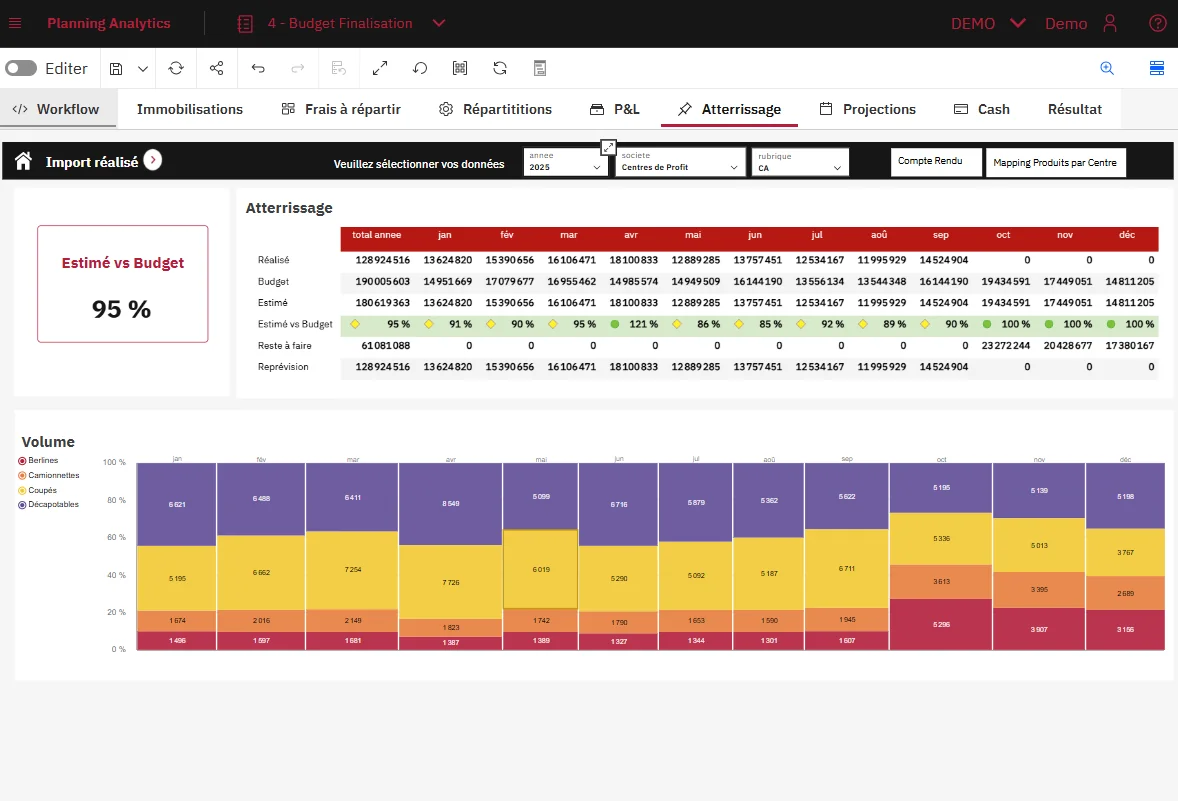
From static budgeting to continuous performance management
Traditionally, budgets are built once a year and revised only marginally. This approach quickly shows its limits when initial assumptions no longer hold true.
IBM Planning Analytics introduces a continuous performance management approach by constantly comparing budget, actuals, and forecasts to secure decision-making.
Dashboards for rapid understanding
Dashboards provide a consolidated view of key indicators such as revenue, margins, costs, and net result.
Thanks to Actual vs Budget comparisons and dynamic visualizations, decision-makers can immediately identify significant variances and risk areas.
Analyze variances to make better decisions
Beyond simple observation, variance analysis helps explain deviations and understand underlying trends.
Multi-dimensional analyses (products, departments, customers) provide a detailed understanding of performance drivers.
Anticipate through forecasting and year-end outlook
Forecasting functions make it possible to anticipate the year-end outlook early.
Finance teams can adjust the trajectory during the fiscal year, rather than reacting to results at closing.
Web and Excel: the best of both worlds
IBM Planning Analytics relies both on modern web interfaces that facilitate deployment and on Excel, which remains a central tool for many users.
These two interfaces ensure rapid adoption without disrupting usage, while relying on a single, reliable data model.