

Sales Leader France & Benelux. Responsible for IBM license sales and AEXIS solutions, from scoping to licensing, renewals, and software + services bundles.
In many AI projects, the first version of an agent looks convincing for a few minutes, then quickly shows its limits as real-world cases become more precise. A rule is missing, a tool is missing, a constraint is missing, a business rewording is missing, or a guardrail is missing on what the agent is allowed to infer. watsonx Orchestrate AI Builder is interesting precisely because it structures this improvement phase. It allows you to create an agent from an intention, refine its instructions, revise its definition, and progressively make it more robust. For AEXIS, this logic is essential: an agent only has value if it becomes reliable, understandable, and manageable in a real business context.
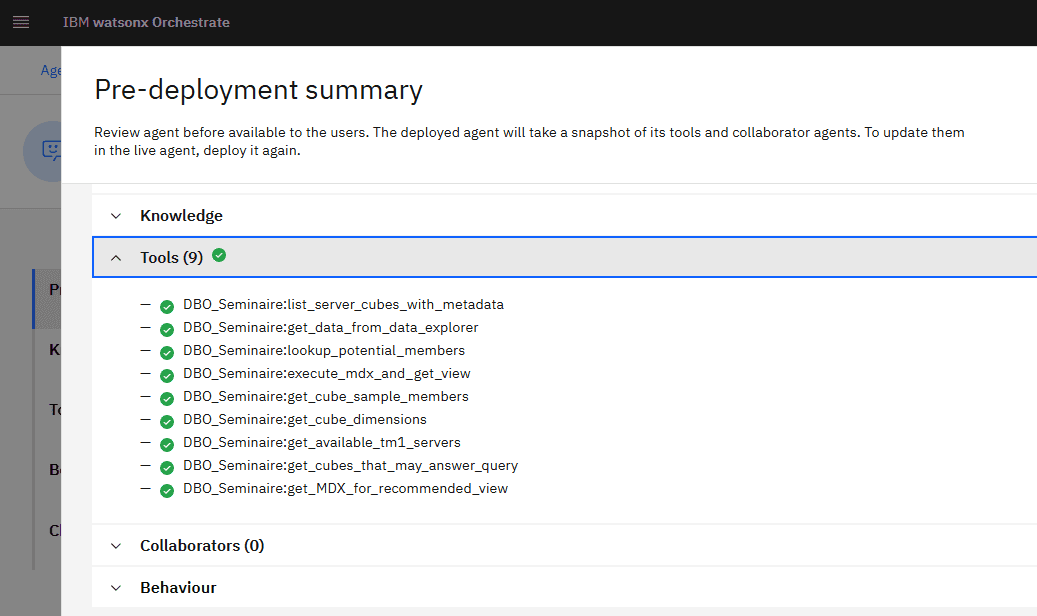
A useful agent starts with a well-defined role
Most errors appear when an agent is asked to be too broad, too vague, or too autonomous without a precise framework. The result is appealing but uneven answers, with behaviors that are difficult to anticipate.
The first step is therefore to define the exact role of the agent: what it must do, what it must not do, which situations it handles, and in which cases it must rely on a tool or redirect the request.
AI Builder helps turn an intention into an operational definition
The value of AI Builder is not just to generate text. It helps structure an agent from a need expressed in natural language, then improve it by progressively refining instructions, expected behaviors, and reusable elements.
This approach is particularly useful for bringing business and technical teams closer together. It makes it possible to start from an intention that business users can understand while converging toward a more explicit and more controllable agent definition.
Making an agent more reliable means reducing improvisation zones
An agent that takes too many initiatives on calculations, interpretations, or implicit assumptions quickly becomes risky. In business processes, it is essential to clearly define what belongs to allowed reasoning and what must necessarily go through a tool, a source of truth, or a validation step.
This discipline is where true maturity comes from. The objective is not only to make the agent more intelligent; it is to make it more predictable, more consistent, and safer in its behavior.
Tools and instructions matter as much as the model
Many organizations overestimate the choice of model and underestimate agent design. Yet in practice, a good agent depends heavily on the quality of the connected tools, the precision of the instructions, and the way expected responses are framed.
AI Builder is especially valuable when it is used to articulate these building blocks properly: business intent, instructions, available tools, action boundaries, and the posture expected toward the user.
The AEXIS approach: from an impressive prototype to an operational agent
At AEXIS, we do not aim to produce an agent that is impressive only in demonstration. We aim to build an agent capable of delivering lasting value within a clearly defined scope.
This requires framing, testing, adjustment, and prioritization work. This is the method that transforms a proof of concept into an agent that is truly useful for finance, IT, support, or cross-functional teams.